
Welcome to The Graduate’s Guide™
Welcome! I’m so glad you’re here.
I created The Graduate’s Guide™ for young people who are stepping into adulthood and discovering that there are a whole lot of things no one actually teaches you in school.
How do you navigate your first workplace? How do you manage your money when you finally start earning it? How do you handle the everyday decisions, relationships, responsibilities, and occasional messes that come with being an adult?
That’s what I want to talk about here.
Think of me as your Aunt Anna (not your mom). I’m simply someone who has been where you are now. I’ve been the young person just starting out. I’ve built a career and a business. I’ve raised two sons and watched them begin adult lives of their own. And at 51, I even went back to school and became the student again.
Along the way, I’ve learned a lot—sometimes because someone gave me great advice and sometimes because I had to learn it the hard way.
My goal with this blog is to share that experience with you in a way that is practical, straightforward, and actually useful. We’ll talk about career, money, and life—the things that become increasingly important once the graduation cap comes off and real life begins.
And I hope you’ll come back again and again. Sometimes you may be looking for an answer to a specific question. Other times, you may simply stumble across something you didn’t know you needed to know yet. Either way, I want The Graduate’s Guide™ to become a place where you know you can find common-sense guidance you can trust and actually use.
And we’re going to jump right into some of the biggest issues facing young people today. In my next blog, we’ll talk about artificial intelligence and what it means for young people trying to get and keep a good job in a workplace that is changing faster than ever. It’s a conversation I think every young person entering the workforce needs to be having.
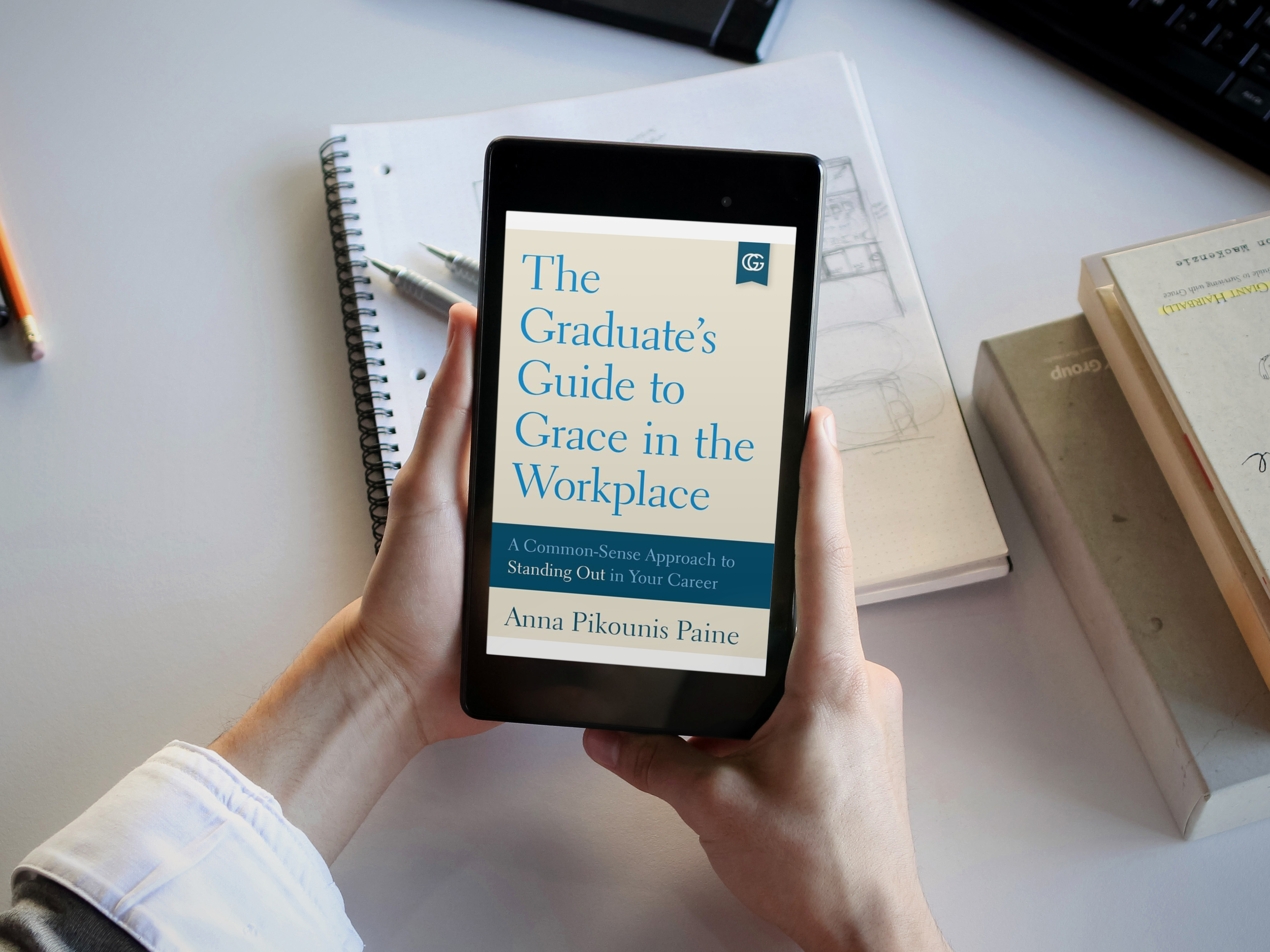
Since this is my first blog post, I thought the best way to introduce myself and The Graduate’s Guide™ would be to share something with you that I normally reserve for readers of my first book, The Graduate’s Guide to Grace in the Workplace: A Common-Sense Approach to Standing Out in Your Career.
Below, I’m sharing the full Introduction from the book. It explains why I wrote The Graduate’s Guide to Grace in the Workplace, what more than thirty years in the workplace taught me, why I believe professional behavior matters just as much as professional performance, and where my “Aunt Anna” approach to advice came from. Most importantly, it will give you a pretty good sense of who I am, how I think, and what you can expect when you come back here.
So, consider this our official introduction.
I’m Aunt Anna. Welcome to The Graduate’s Guide™.
Now, let me tell you how this all started . . .
Introduction
Congratulations! Whether you are graduating soon or have already graduated from high school, a trade school, a certification program, a training institute, or college, you achieved an academic goal you set for yourself, and you should be very proud. Your education will benefit your life in so many ways, but most importantly by providing you with the academic credentials necessary to find a job in your field and be financially independent. This independence is crucial to becoming your own person and forging your individual path for the rest of your life.
What You Didn’t Learn in School
As you enter the workplace, you will apply what you learned from your education and other work experience. But were you ever offered a class on how to navigate workplace settings? This book is your go-to guide on professional workplace behavior.
Make no mistake. Your employer expects you to conduct yourself in a professional manner at all times from day one. They have the right to that expectation, and you should oblige. Understand right now that you are on their clock. Your behavior represents them, and you should always be mindful of this commitment.
Professional behavior involves aligning with company values, portraying a positive professional image, and contributing to organizational success. Professional behavior, like most behaviors, is not innate. As I presented earlier in the “Letter to the Reader,” humility, manners, work ethic, and kindness (HMWK) are all integrated into professional workplace behavior, but we are born with none of them. We learn these behaviors from the people in our world and from society in general as we grow up. Ultimately, it is your responsibility to behave appropriately based on this knowledge, to determine the best methods to exhibit this behavior, and then apply those methods. This book provides the methods you can use in the professional setting.
Why Professional Behavior Is Critical to Your Success
Most of us will work 40+ hours per week, which means you are in the workplace approximately 40% of your awake time during the 40+ years of your career. Wow! That’s a lot of time spent with people who are not your family or close friends. You want to ensure that your actions with coworkers contribute to respectful work relationships, which may even evolve into friendships.
You might be asking yourself, Does the company really care how I act, as long as I work hard and increase its bottom line? Isn’t my career advancement mainly based on my work performance? The answer is that both work performance and workplace behavior influence management decisions to advance your career. They are not mutually exclusive. The most significant difference between the two is that the evaluation of your work performance is typically much more objective, quantitative, and measurable, whereas the behavior component is mostly subjective. If you exhibit excellence in both areas, you will thrive.
But let’s be honest. As much as you want to thrive in your new career, you also simply want to keep your job. Job security can be very unpredictable. Throughout the first quarter of the twenty-first century, several significant events have proven this: the 2008 global financial crisis, the 2020 pandemic, and the emergence of artificial intelligence (AI), via large language models (LLMs) like ChatGPT, in 2022. Whether or not you were aware of, or remember, the details of the 2008 Great Recession, you or your family likely knew people who lost their jobs. The 2020 pandemic showed us how quickly the entire global economy can be shut down, through no fault of our own, and create widespread economic destruction. Currently, the global race for AI has placed enormous pressure on employers to implement it with the emphasis on reducing workforce or risk losing competitive advantage. These are extreme examples, but you get the point.
Even at a time when the economy is better, even thriving, you are never guaranteed your job. According to the US Department of Education, over four million students graduate from trade schools or colleges every year, which means competition for good jobs is always fierce.
It’s extremely important to develop a competitive advantage, which includes your job performance, certifications earned, and so on, but also includes how your level of professionalism is perceived by your superiors. The Graduate’s Guide is here to help you with the latter.
What I Know About Professional Behavior
The Graduate’s Guide is not yet another etiquette book written by a self-proclaimed expert on the subject. To my knowledge, no certification, license, or degree from a nationally accredited source exists for workplace etiquette, which is really just a fancy way of saying good behavior. While it can be defined in many ways, we know good behavior when we see it. We also know when we don’t, and so do your boss and coworkers. So, I will not use the “E” word in this book to describe good behavior. Let’s call it what it is—common sense. Unfortunately, what constitutes common sense may not necessarily be common knowledge.
What makes the information in this book so useful is the source of information—my real-life experiences in the workplace for over thirty years. Once upon a time, I was you—one of the youngest employees in the company, just starting out, with very little idea of what to expect when I arrived at my new job. I’ve been a certified public accountant since 1994, with most of that time spent as the owner of my own firm and almost all my work performed at clients’ offices. So, from my early years at Deloitte, one of the Big Four accounting firms, where my job involved auditing public companies across the country, to my current work as an outsourced controller for small and midsize businesses, I’ve seen just about every kind of workplace: private investment firms, construction companies, bakeries, preschools, even an international music celebrity’s office—you name it. And I have witnessed my share of questionable behavior among young professional staff. Sometimes it’s a matter of poor judgment, like making personal calls from the work cubicle or showing up to work with wet hair. Other times, it’s more serious, like being unprepared for meetings or missing deadlines. The Graduate’s Guide is built to help you navigate all of it, wherever your career takes you.
Today, I am a workplace veteran who observes the younger versions of me in the work setting. Through many years of observation, I’ve determined that the questionable behavior of younger employees doesn’t mean they are bad people or have no common sense. On the contrary, I’ve figured out that no one has probably ever taken the time to convey the general workplace behavior expectations to new staff. Oh sure, many companies offer impeccable training, comprehensive employee policies and procedures manuals, and step-by-step paths to company advancement, but no one talks about this other critical behavioral expectation. That’s so unfortunate, because knowledge is power, and the lack of knowledge in this area can knock you down and out with no warning.
I am not an expert, nor do I need to be in order to pass on some good, friendly common-sense advice. Think of me as your Aunt Anna (not your mom), whom you love to spend time with at family dinners on Sunday because she always has some wisdom to share . . . and makes a mean Insta-worthy Greek pastitsio! My goal is not to lecture but to equip you with the tools and perspective I wish someone had shared with me. Take these lessons, apply them, and trust that they will serve you well. You’ll make mistakes— everyone does—but you’ll learn, adjust, and grow into the professional you aspire to be. One day, you’ll be in the position to guide someone else just starting out. That is how strong careers, and strong professionals, are made.
How to Get Started
First, make sure you’ve read the “Letter to the Reader” and have spent some time on your reflection. Next, read the book in its entirety. Yes, the whole thing. You can do it! Then go back, review one chapter each day, and practice the Daily Life Lessons described earlier for the first two weeks of your job. This is a good time to also practice applying HMWK regularly. Once these behaviors become second nature, you can then occasionally refer back to the book when you encounter bumps or anticipate new situations at work. For example, imagine your boss has just invited you to lunch with the team and you’ve got fifteen minutes to figure out how not to say or do something awkward. Flip to chapter 5, “Grub, Gigs, and Grace,” for a quick dose of dos and don’ts, as well as confidence. You will walk in calm, cool, and totally lunch-ready.
The Graduate’s Guide is written in a way to be informative and concise. After all, who has time to read a three-hundred-page book? You work now! The good news is that the book is just the right length—long enough to be jampacked with good information but short enough to get through quickly.
It’s also organized in three key sections to make it easy to start, stop, and retain. Part One, “The First Impression,” explores how your appearance and personal workspace shape how others perceive you. This section is straightforward with brief bullets that are self-explanatory. Part Two, “The Next Impression,” centers on your performance, reliability, and job security. This section is a bit more in-depth with more serious topics and recommendations. The final section, “The Last Impression,” addresses the professional steps involved before and after leaving a job, and it warrants the same attention as all previous chapters, even if the advice is looking way into the future (we hope!).
Each section’s chapters have an introduction to a specific topic followed by simple key points. That’s it. This format allows you to read the entire book in great detail or simply touch on the key points of one chapter as a real-time refresher. I used this format because (1) I’m more of a “cut to the chase” technical writer, (2) you’re smart enough to get the point without the fluff, and (3) we both have better things to do than to read (or write) unnecessary details. I guarantee you won’t get bogged down by endless anecdotes or redundant explanations about how each concept relates to HMWK either. That said, I encourage you to research the many subjects in the book in greater depth based on your own work situation. Many of these subjects, such as appropriate attire, are workplace-specific, and no single book can cover them all.
The book is also written in broad terms, so its lessons apply to virtually any workplace from a centralized nursing station in a Los Angeles hospital emergency room to a construction trailer on a jobsite in Topeka, to an open stock-trading pit in New York, or even a Disney call-center cubicle in Orlando. Because no two workplaces are exactly alike, I vary the terminology throughout the book using words like workplace, company, organization, and employer, along with boss, supervisor, colleague, peer, and coworker. Remember, this book is your go-to guide on professional workplace behavior. It is not meant to circumvent or supplant any policies established by your workplace. It’s just some good common-sense advice from your Aunt Anna, and the goal is simple: Take the advice and adapt it to your own unique work environment.
Let’s get started!
Very truly yours,
Aunt Anna
